2026 STD Awareness Week

An official website of the State of Georgia.
The .gov means it’s official.
Local, state, and federal government websites often end in .gov. State of Georgia government websites and email systems use “georgia.gov” or “ga.gov” at the end of the address. Before sharing sensitive or personal information, make sure you’re on an official state website.
Still not sure?
Call 1-800-GEORGIA to verify that a website is an official website of the State of Georgia.
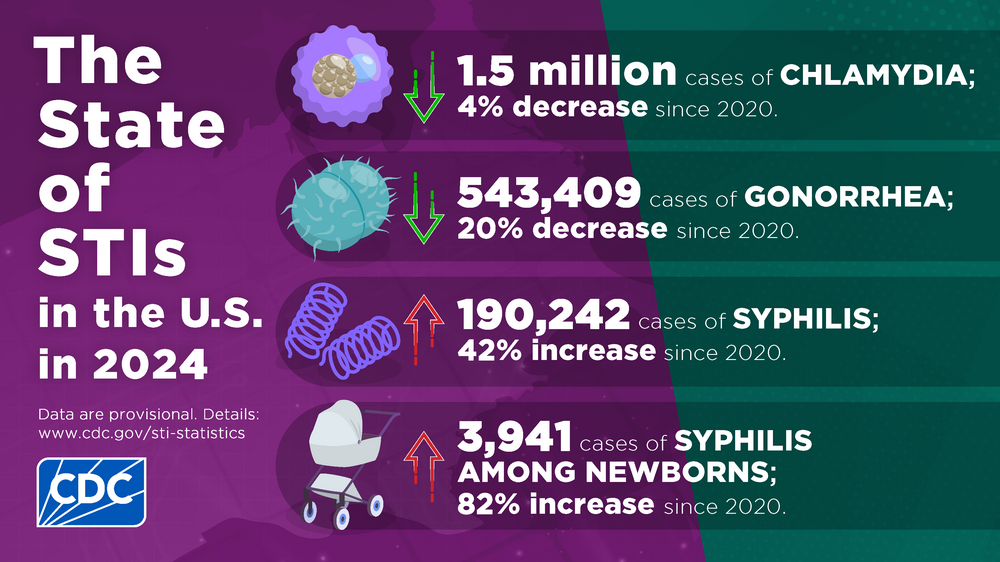
STI Awareness Week is a time to raise awareness about sexually transmitted infections (STIs), reduce stigma, and empower people with the tools they need for prevention, testing, and treatment. Recent CDC provisional data show that in 2024, there were approximately 1.5 million cases of chlamydia (a 4% decrease) and 543,409 cases of gonorrhea (a 20% decrease) in the United States. However, syphilis cases continue to rise, with 190,242 cases reported (a 42% increase since 2020). Congenital syphilis remains a serious concern, with 3,941 cases among newborns—an 82% increase since 2020. In Georgia, STI rates continue to reflect national trends and remain a significant public health concern.
The CDC Talk. Test. Treat. campaign encourages individuals and healthcare providers to take three simple actions to protect their own health and the health of others. Along with regular testing and timely treatment, using condoms correctly and consistently remains one of the most effective ways to reduce the risk of many STIs, including HIV. During STI Awareness Week, health districts across Georgia are also hosting a schedule of events, including free testing opportunities, community outreach, and awareness activities to help individuals access prevention and care services.
Georgia offers free condoms through local health departments and confidential mail-order programs.
📬 Find free condoms near you: Find Georgia free mail-order condom distribution programs
Georgians
If you are sexually active or thinking of becoming sexually active, it is important to Talk. Test. Treat. to protect your health. These three simple actions can have a big impact on your sexual health.

Talk openly and honestly to your partner(s) and your healthcare provider about sexual health and sexually transmitted infections, or STIs.
Talk with your partner(s) BEFORE having sex. Not sure how? We have tips to help you start the conversation. Make sure your discussion covers several important ways to make sex safer:
Talk with your healthcare provider about your sex life as it relates to your health. This helps your healthcare provider understand what STI tests you should get and how often.
Here are a few questions you should expect and be prepared to answer honestly:
Not all medical checkups include STI testing, so don’t assume that you’ve been tested unless you discuss it with your provider. If your provider does not discuss sex or STI testing with you, bring it up.
Ask your healthcare provider whether certain vaccines, such as the hepatitis B vaccine or the HPV vaccine, are right for you.
Get tested. It’s the only way to know for sure if you have an STI.
Many STIs don’t cause any symptoms, so you could have one and not know. If you’re having sex, getting tested is one of the most important things you can do to protect your health.
Learn which tests the CDC recommends for you. Even if you’re pregnant, you can still get an STI. If you’re having sex, you’re still at risk.
Find out what STI care options are available near you. In addition to traditional, in-person visits, other options that may be available include:
If you’re not comfortable talking with your regular healthcare provider about STIs, find a clinic near you that offers confidential testing that is free or low-cost.
If you test positive for an STI, work with your healthcare provider to get the correct treatment.
Some STIs can be cured with the right medicine, and all STIs are treatable. Make sure your treatment works by doing these things:
Your healthcare provider can talk with you about which medications are right for you.
Providers
The idea of Talk. Test. Treat. is simple, but STI prevention and treatment are not one-size-fits-all. Providers play a key role in helping patients access prevention, testing, treatment, and follow-up care.

Providing the best medical care possible means talking to your patients about sexual health.
Taking a sexual history should be a part of routine care.
Talking about sexual health can be challenging, but studies show that patients want to be asked about sex. The following tips can help to ensure the most productive conversations with your patients:
Counsel your patients on safer sex, and ensure that they know about today’s many prevention options. With condoms, hepatitis B and HPV vaccines, and even a daily medication to prevent HIV infection, there have never been more ways for your patients to protect themselves.
Specific STI diagnoses can cause fear and anxiety in your patient.
Use CDC counseling messages in the 2021 STI Treatment Guidelines to help alleviate these concerns.
Test your patients for STIs as recommended.
Use the sexual history to determine which STIs you should test for and the anatomical sites to test.
STI screening recommendations for different patient populations are available. Below is a brief overview.
Remember that screening recommendations are sources of clinical guidance, not prescriptive standards. Always consider a patient’s sexual history and the burden of disease in their community.
Once a patient has been tested, make sure they know how they will get their test results.
Follow CDC’s STI Treatment Guidelines to ensure appropriate treatment and care.
The 2021 STI Treatment Guidelines are the most current recommendations for treating patients with or at risk of infection.
Important treatment topics to be aware of:
Expedited Partner Therapy (EPT) may be an option in cases where a patient’s partner is unwilling or unable to access care.
Reinfection is common for some STIs. Encourage your patients to return for follow-up testing in three months.
Drug-resistant gonorrhea is an immediate public health threat requiring urgent and aggressive action.
Preserve our last treatment option by only treating your patients with the recommended treatment (ceftriaxone 500mg intramuscularly in a single dose).
Page last updated 4/13/26