HIV_EPI_IMAGE_Network_Detection_Response_Wheel_Puzzle_508_202605.png
An official website of the State of Georgia.
The .gov means it’s official.
Local, state, and federal government websites often end in .gov. State of Georgia government websites and email systems use “georgia.gov” or “ga.gov” at the end of the address. Before sharing sensitive or personal information, make sure you’re on an official state website.
Still not sure?
Call 1-800-GEORGIA to verify that a website is an official website of the State of Georgia.
Network Detection and Response (NDR), previously known as Cluster Detection and Response (CDR), is the Georgia Department of Public Health's (GA DPH) new laboratory and epidemiological approach to help identify communities affected by recent and rapid transmission of HIV. GA DPH previously used the term “cluster” to align with CDC terminology, but began using the term “network” after receiving feedback from the Georgia Cluster Detection and Response Community Advisory Board in 2025 that the term “network” was preferred because it was less stigmatizing compared to the term “cluster.”
The HIV Epidemiology Unit at GA DPH has been conducting HIV NDR work since 2018, which includes:
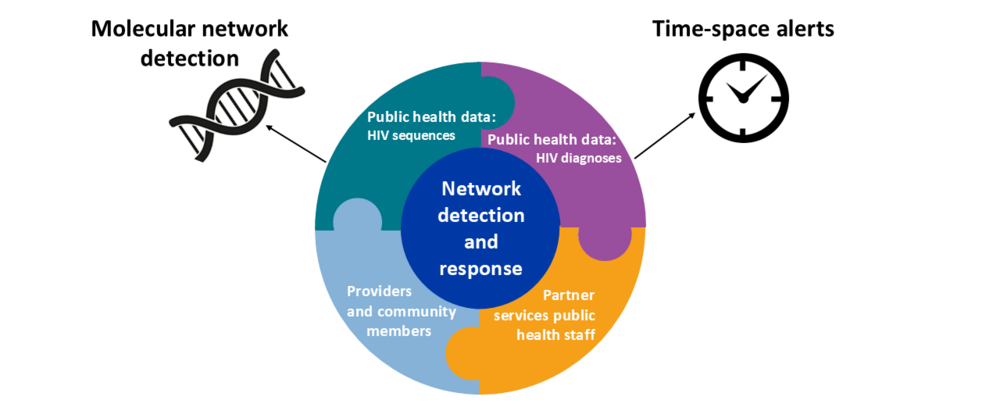
A circular puzzle-style diagram illustrating “Network detection and response” in HIV public health. At the center is a dark blue circle labeled “Network detection and response.” Surrounding it are four interlocking segments: (1) teal segment labeled “Public health data: HIV sequences,” (2) purple segment labeled “Public health data: HIV diagnoses,” (3) orange segment labeled “Partner services public health staff,” and (4) light blue segment labeled “Providers and community members.” To the left, an icon of a DNA strand is labeled “Molecular network detection,” and to the right, a clock icon is labeled “Time-space alerts,” with arrows pointing from these icons toward the central circle.
Network Detection and Response Aims: Molecular network detection and time-space alerts create an opportunity to identify gaps in HIV prevention and care services that may not be detected through other efforts. These analyses help GA DPH prioritize resources where HIV is spreading quickly, which allows for early intervention to prevent further spread.
Molecular networks are a subset of a larger transmission network, in which other individuals with HIV are either diagnosed but do not have a sequence or are undiagnosed and unaware of their status. Both molecular networks and transmission networks are connected to larger social networks, individuals who share behaviors, but may not have HIV.
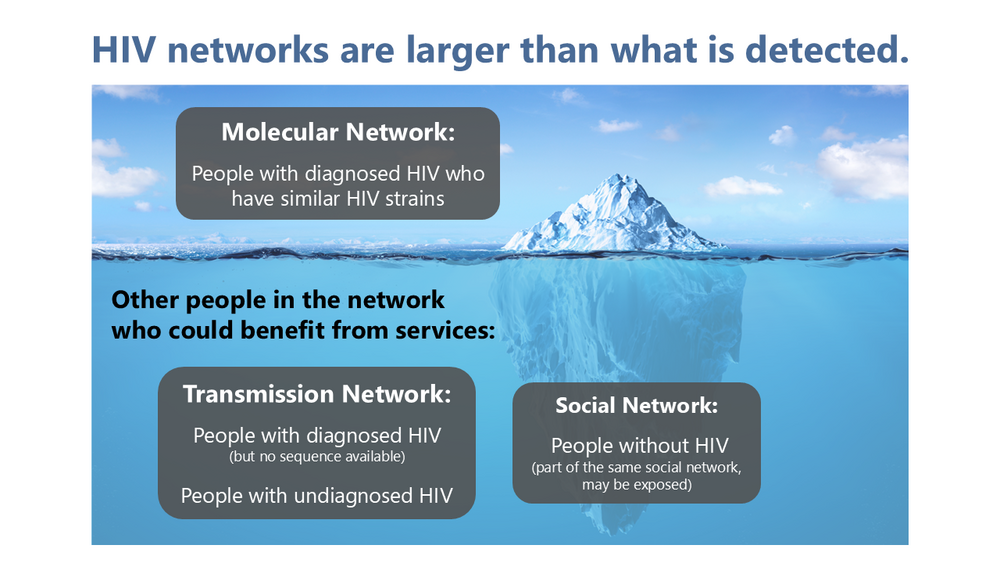
An iceberg graphic illustrates that “HIV networks are larger than what is detected.” Above the waterline, a small visible portion of the iceberg is labeled “Molecular Network: People with diagnosed HIV who have similar HIV strains.” Below the waterline, a much larger submerged portion represents additional people in the network who could benefit from services. This includes a section labeled “Transmission Network: People with diagnosed HIV (but no sequence available) and people with undiagnosed HIV,” and another section labeled “Social Network: People without HIV (part of the same social network, may be exposed).”
When responding to networks, public health organizations can implement interventions at the individual, network, and systems level (see figure below).
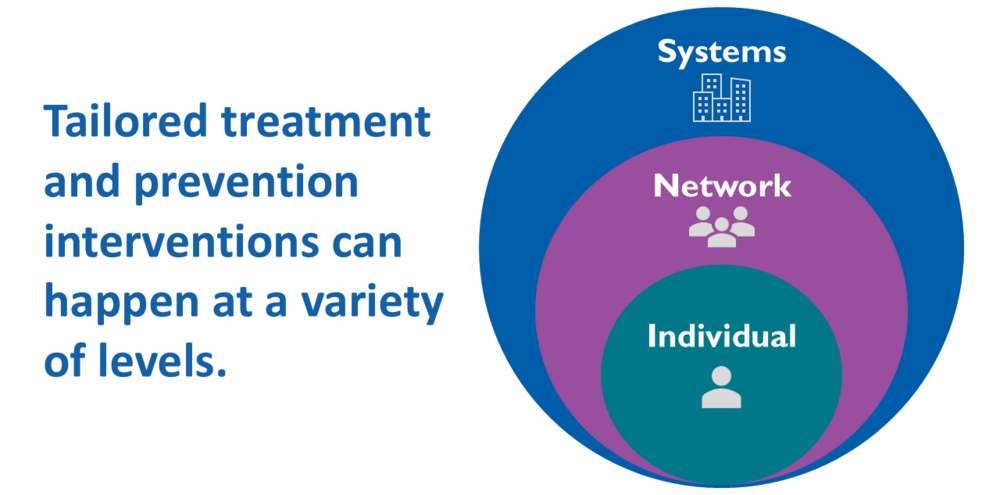
The above diagram shows that tailored treatment and prevention interventions can occur at multiple levels. On the right, three nested circles represent these levels: a small inner circle labeled “Individual” with a person icon, a middle circle labeled “Network” with a group of people icon, and a large outer circle labeled “Systems” with a buildings icon. On the left, text reads: “Tailored treatment and prevention interventions can happen at a variety of levels.”
Alerts occur when there is an increase in HIV diagnoses in the past 12 months compared to the prior 3-year average (“time”) occurring in the same county at diagnosis (“space”). GA DPH then investigates the alert to determine if there is ongoing HIV transmission and to direct intervention efforts.
Time-space alerts are particularly useful for detecting increasing diagnoses among people who inject drugs and in areas with smaller populations or lower rates of HIV.
Alerts will sometimes identify increases that are a result of increased testing, population growth, or improved access to care, and not necessarily increased HIV transmission. It is important to consider local context, other molecular network detection findings, and overarching diagnosis trends when interpreting alerts. For example, alerts can be affected by the lower number of HIV diagnoses that occurred during the COVID-19 pandemic.
Posters and presentations provide more details about networks and time-space alerts in Georgia.
For more information on CDC’s national CDR efforts and findings, see: CDC HIV Cluster and Outbreak Detection and Response | CDC
Case Reporting: For instructions on how to report HIV/AIDS cases and lab reports, see HIV/AIDS Case Reporting.
How To Request Data: To request data beyond what is included on the GA DPH website, please visit PHIP Data Request to create a PHIP data request account and complete the data request form.
Director of Viral Hepatitis, HIV, and STI Epidemiology Section
Dr. Jenna Gettings, DVM, MPH
[email protected]
Page last updated 02/12/2026